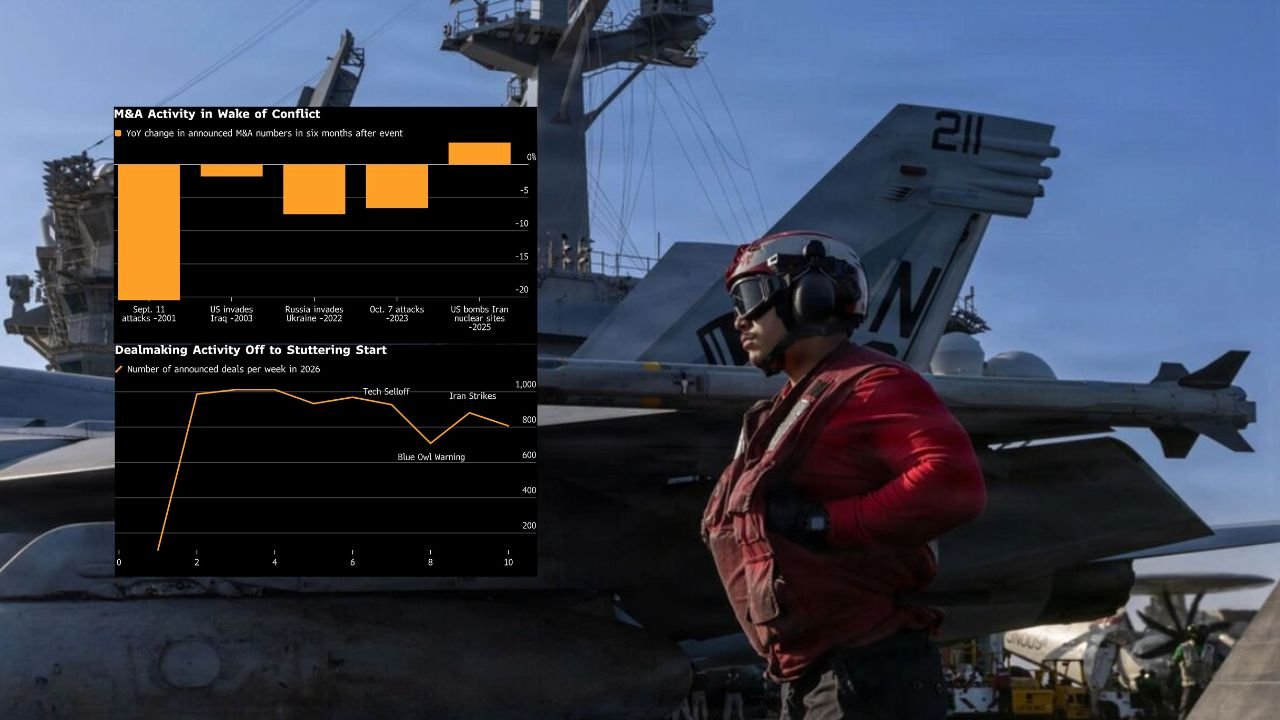
Global dealmakers are starting to feel the impact of rising geopolitical tensions. As the conflict involving Iran escalates, bankers and corporate advisors say mergers and acquisitions (M&A) activity is becoming more cautious.
While deals are not collapsing outright, timelines are stretching and companies are taking extra time to review risks. For an industry that began 2026 expecting record-breaking deal activity, the sudden uncertainty has created a new challenge.

The shift shows how quickly global events can affect corporate strategy, financing decisions, and investor confidence.
Why the Iran Conflict Is Affecting M&A Activity
Corporate mergers and acquisitions depend heavily on market stability. When geopolitical risk rises, companies often pause major decisions until the outlook becomes clearer.
Advisory bankers say the current environment is creating a “proceed with caution” mood among dealmakers.
Key factors slowing deals
- Rising geopolitical uncertainty in the Middle East
- Volatility in global stock markets
- Concerns about inflation from higher energy prices
- Tighter scrutiny during due diligence processes

According to deal advisors, transactions are still moving forward, but negotiations are taking longer.
Companies want to fully assess potential risks before finalizing large acquisitions.
Historical Data Shows Conflicts Often Slow M&A
Past crises show a clear pattern: mergers and acquisitions tend to decline after major global events.

Bloomberg data indicates that M&A activity often drops in the months following significant geopolitical shocks.
M&A activity after major crises
| Event | Impact on Global Deals |
|---|---|
| September 11 attacks | Deal activity dropped more than 20% |
| Global financial crisis | Major slowdown in acquisitions |
| Pandemic uncertainty | Temporary freeze in large deals |
The same pattern may now emerge if tensions in the Middle East continue.
Deal Activity Already Showing Signs of Slowing
Even before the conflict intensified, global M&A activity was already losing momentum.
Data shows that the number of announced deals in 2026 is currently more than 13% lower than the same period in 2025.
Compared with the record year of 2021, deal numbers are about 25% lower.
Several factors were already contributing to the slowdown:
- Declining technology stock valuations
- Concerns in private credit markets
- Investor caution toward high-risk sectors
The Iran conflict is now adding another layer of uncertainty.
Large Deals Are Still Happening
Despite the cautious environment, some major acquisitions have moved forward this year.
Recent headline deals include:
- Devon Energy acquiring Coterra Energy assets in a deal worth about $21.4 billion
- A $10.7 billion takeover of AES Corporation by investors including Global Infrastructure Partners and EQT AB
These transactions suggest that dealmaking momentum has not completely disappeared.
However, advisors say companies are moving more carefully.
Why Due Diligence Is Becoming More Intense
One of the biggest changes in the current environment is the level of scrutiny applied to deals.
Before finalizing an acquisition, buyers conduct detailed due diligence to understand financial, legal, and operational risks.
With geopolitical tensions rising, companies are expanding that process.
Areas getting closer attention
- Supply chain exposure to Middle East energy markets
- Sensitivity to inflation and commodity prices
- Financing costs for large acquisitions
- Market reaction to potential announcements
More detailed analysis can slow the pace of negotiations and delay closing timelines.
Financing Risks Could Affect Mega Deals
Another concern is the cost of borrowing.
Large corporate acquisitions often rely on loans or private credit financing. If inflation rises because of higher oil prices, interest rates could remain elevated.
That would make funding large takeovers more expensive.
Financial advisors warn that this could affect mega deals worth billions of dollars.
In uncertain markets, lenders also become more cautious about extending credit.
Echoes of Market Turbulence Last Year
Some dealmakers say the current environment feels similar to early 2025.
At that time, hopes for a record M&A year were disrupted by new trade tariffs and political uncertainty.
The market eventually recovered once investors adjusted to the changes.
Private equity executives say something similar could happen again.
If geopolitical tensions ease, deal activity may rebound later in the year.
Why Some Companies May Still Move Forward
Despite uncertainty, several factors still support mergers and acquisitions.
Positive conditions for deals
- Strong corporate balance sheets
- Availability of investment-grade financing
- Large amounts of private equity capital waiting to be deployed
Many firms also entered 2026 with a strong pipeline of potential acquisitions.
Advisors say companies are unlikely to abandon deals entirely unless market conditions deteriorate significantly.
Key Takeaways
- Rising Middle East tensions are slowing global mergers and acquisitions.
- Deals are not being canceled but timelines are becoming longer.
- Global M&A numbers are already down more than 13% this year.
- Higher energy prices could increase borrowing costs and affect financing.
- Strong corporate balance sheets still support continued deal activity.
FAQs
Why do wars affect mergers and acquisitions?
Conflicts create economic uncertainty, making companies cautious about committing billions of dollars to large transactions.
Are deals being canceled?
Not yet. Most deals are still moving forward, but negotiations and due diligence are taking longer.
Could M&A activity drop further?
Yes. If the conflict raises energy prices or slows global growth, deal activity could decline further.
What sectors are most affected?
Technology, energy, and infrastructure deals are particularly sensitive to market volatility and financing costs.
Will dealmaking recover later this year?
It is possible. If markets stabilize and geopolitical tensions ease, mergers and acquisitions could rebound.
Conclusion
The global mergers and acquisitions market entered 2026 with strong expectations for another record year. But geopolitical tensions, especially the conflict involving Iran, have introduced new uncertainty.
For now, dealmakers are adapting rather than abandoning plans. Companies are taking more time, conducting deeper due diligence, and waiting for clearer market signals.
If stability returns, the M&A pipeline could quickly regain momentum. But if tensions escalate, corporate dealmaking may face its toughest test of the year.